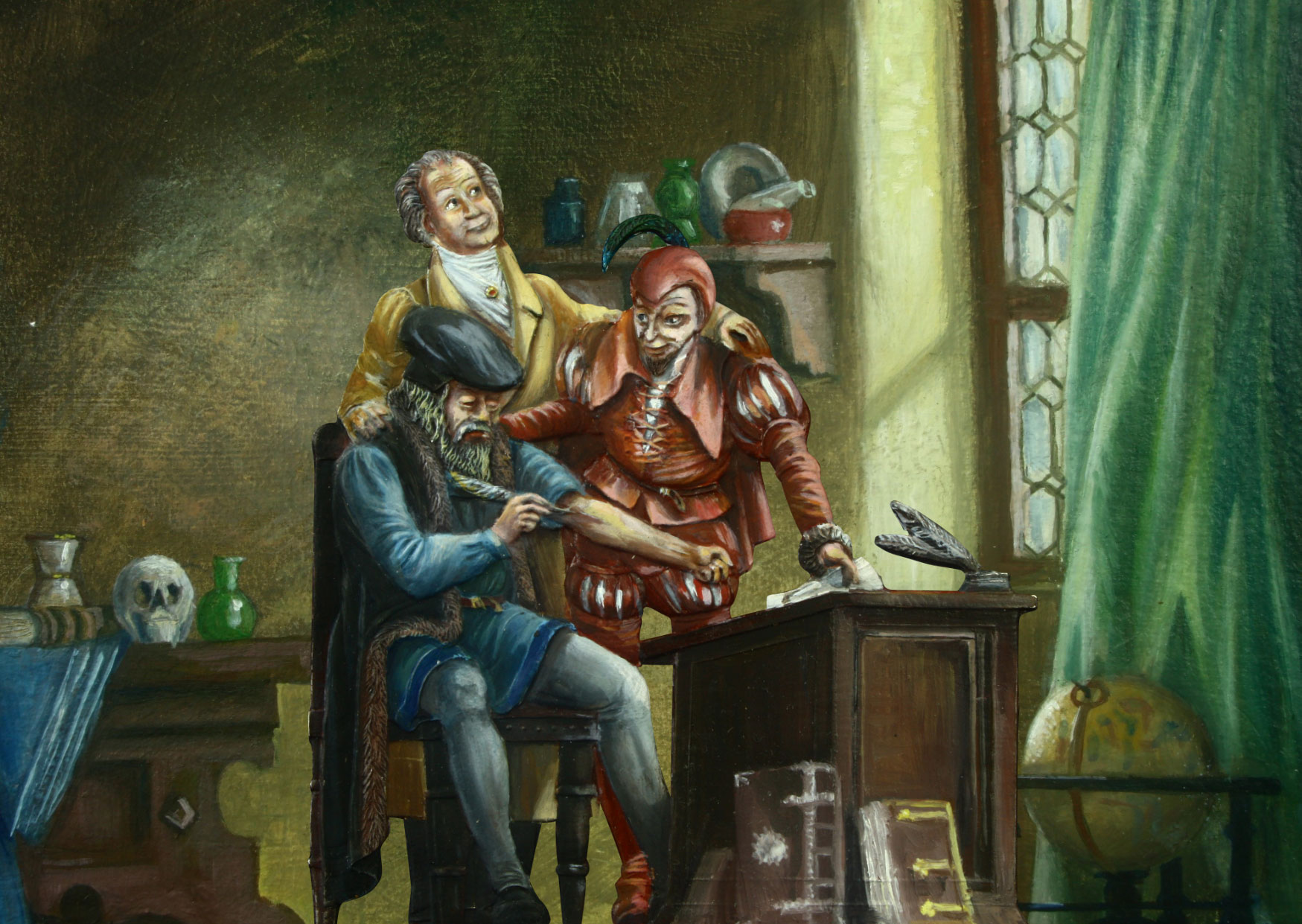
Neues Set zu Goethes Faust II
»Auf dem Vorgebirg«
Obergeneral Faust und die Geisterschlacht
Faust als Feldherr, Mephisto als Magier

In der Szene »Auf dem Vorgebirg« des vierten Akts von Goethes Faust II tobt eine gewaltige Schlacht zwischen dem kaiserlichen Heer und den aufständischen Truppen des Gegenkaisers. Faust und Mephisto eilen dem Kaiser erneut zu Hilfe. Bereits im ersten Akt des Dramas hatten sie das Reich gerettet, indem sie den Kaiser überredeten, Papiergeld zu drucken. Mit Mephistos teuflischen Zauberkräften und den von ihm herbeigezauberten Drei Gewaltigen – Raufebold, Habebald und Haltefest – besiegt der magische Obergeneral Faust das aufständische Heer. Als Belohnung für seinen entscheidenden Beitrag wird Faust – wie im zuletzt erschienenen Zinnfigurenset »Des Gegenkaisers Zelt« dargestellt, zum Ritter geschlagen und erhält das Meeresufer, wo er sein großes Kolonisationsprojekt verwirklichen kann, wie im fünften Akt noch zu sehen sein wird. Miniaturmalung dieser Abbildung Reihold Pfandzelter.

Mehr Informationen zu diesem Zinnfigurenset finden Sie im Booklet.

Der geharnischte Obergeneral Faust, der Kaiser und Mephisto mit seinen beiden Raben. Miniaturmalung von Philippe Fourquet. »Was sollen diese leidigen Vögel?«, fragt der Kaiser. »Von Tauben hast du ja vernommen, die aus den fernsten Landen kommen, zu ihres Nestes Brut und Kost. Hier ist’s, mit wichtigen Unterschieden. Die Taubenpost bedient den Frieden, der Krieg befiehlt die Rabenpost«, antwortet Mephisto. Und zu den beiden Rabenkundschaftern: »Setzt euch ganz nah zu meinen Ohren. Wen ihr beschützt, ist nicht verloren, denn euer Rath ist folgerecht.«

In der nordischen Mythologie sind Hugin und Munin die beiden Raben, die Odin, den Gott der Krieger, begleiten. Sie sind seine Augen und Ohren. Odin schickt sie aus, um die Welt zu erkunden und Nachrichten zu sammeln.
Foto von der Homepage Wikinger Welt.

Die Drei Gewaltigen. Miniaturmalung Philippe Fourquet
Die Drei Gewaltigen sind irreguläre Krieger, die Mephisto herbeigezaubert hat. Sie werden helfen, die Schlacht für den Kaiser zu gewinnen. Ausdrücklich verweist Goethe in seiner Regieanweisung auf die Analogie zu den biblischen Drey Vornehmsten unter den Kriegshelden König Davids (2. Buch Samuel 23,8-13). Üblicherweise wird in Theateraufführungen oder bildlichen Darstellungen des Fausts dieser Hinweis übergangen und die Drei Gewaltigen werden im Stil der Renaissance dargestellt. Mit den hier vorgestellten Zinnfiguren werden Raufebold, Habebald und Haltefest als die biblischen Kriegshelden David, Benaja und Schamgar dargestellt. Benaja war der Hauptmann der Elitetruppe König Davids. Schamgar tötete mit einem Ochsenziemer 600 Philister. König David besiegte bekanntlich schon in jungen Jahren den Riesen Goliath mit seiner Steinschleuder. Die Abbildung zeigt den Krieger Benaja aus der Youtube-Animation »Bible Warriors«.
Das Porträt Kaiser Maximilians I. von Peter Paul Rubens aus dem Jahre 1618 diente als Vorlage für den gerüsteten Herrscher. Maximilian I. war vom 4. Februar 1508 bis zu seinem Tod am 12. Januar 1519 Kaiser des Heiligen Römischen Reichs Deutscher Nation. Das Originalgemälde kann im Kunsthistorischen Museum Wien besichtigen werden.
Zum Set, verpackt in einer hochwertigen Kartonage, gehören 6 unbemalte Zinnfiguren in 30 mm Größe, eine schöne Postkarte als Bemalungsvorlage und ein informatives 8-seitiges Booklet mit vielen Abbildungen. Illustrationen Sascha Lunyakov, Gravuren Werner Otto.
Diese schöne Postkarte als Bemalungsvorlage mit der Miniaturmalung von Philippe Fourquet gehört ebenfalls zum Set.
Lesen Sie auch